Every trade has an origin story, and most are messier than people expect. The history of air duct cleaning starts not with sleek trucks and camera scopes, but with coal soot, wire brushes, and buildings that made people sick for reasons nobody could name yet.
It is a short history as trades go — the industry as we know it is only a few decades old — but it tracks something bigger: the slow realization that the air inside our buildings matters as much as the air outside them. Here is how a niche cleanup chore became a standardized profession.
Before Ducts: Moving Air the Hard Way
Humans have engineered airflow for a very long time. The Romans ran furnace-heated air under floors and through wall channels in their hypocaust systems. Medieval and early-modern builders relied on operable windows, transoms, and vertical smoke shafts. By the 1800s, engineers were designing gravity ventilation shafts into hospitals and public buildings, convinced — correctly, it turned out — that stale air spread disease.
The ancestor of the modern duct arrived with the coal-fired "octopus" gravity furnace of the late nineteenth century: a basement beast with fat metal arms carrying warm air upward through the house. No blower, no filter — just rising heat, and with it, a steady film of coal soot coating every surface the air touched. The first duct cleaning was less a service than a survival chore, done with brooms, rags, and whatever fit down the register.
Forced Air Changes Everything
Two twentieth-century inventions created the modern duct system: the electric blower and affordable sheet metal. By the postwar housing boom of the 1940s and 50s, forced-air furnaces were standard in new American homes, pushing air through networks of ducts at speeds gravity never managed. Central air conditioning followed in the 1960s and 70s, and suddenly the same ductwork ran year-round.
More airflow meant more dust in motion — and more of it settling in places no broom could reach. Early cleaning attempts borrowed whatever other trades had lying around:
- Stiff sweep brushes on long rods, reaching only the first stretch of each run
- Household and shop vacuums parked at the register openings
- Compressed air, blasted in with no plan for where the dust would land
Results were inconsistent at best. Plenty of early operators simply blew the dust from one part of the system into another, or into the living room.
"Old-timers tell stories about crews 'cleaning' ducts with a leaf blower and a prayer. Half the dust ended up on the sofa. The equipment had to catch up with the idea." — the Elite Air Duct crew
The 1970s: Tight Buildings, Trapped Air
The energy crisis of the 1970s changed buildings in a way nobody fully predicted. To save fuel, homes and offices got sealed tight — more insulation, better weatherstripping, less fresh-air leakage. Energy bills went down. Air quality went with them. With less outdoor air diluting the indoor kind, everything circulating in a building stayed in the building: dust, dander, smoke, and the emissions of new synthetic carpets and furnishings.
Terms like "sick building syndrome" entered the vocabulary, and researchers began measuring indoor air seriously. The EPA's studies of human exposure would eventually document that indoor levels of many pollutants run two to five times higher than outdoor levels — a finding that reframed ductwork from tin passageways into part of the building's respiratory system. Demand for real duct cleaning followed, and an industry began forming around it.
1989: NADCA and the Rulebook
Growth attracted both craftsmen and cowboys. With no standards, "duct cleaning" could mean a thorough source-removal job or ten minutes with a shop vac and a coupon. In 1989, a group of contractors founded the National Air Duct Cleaners Association (NADCA) to fix that — writing standards for assessment, cleaning, and restoration of HVAC systems, certifying technicians, and giving homeowners a way to separate professionals from the coupon crowd.
NADCA's core standard established the principle that still defines legitimate work today: source removal. You put the entire system under suction, agitate the debris loose, and capture it — rather than spot-vacuuming whatever the register reveals. Its general guidance for homeowners, inspection regularly and cleaning typically every three to five years as conditions warrant, remains the industry's honest baseline.
The Modern Toolkit: Suction, Agitation, Proof
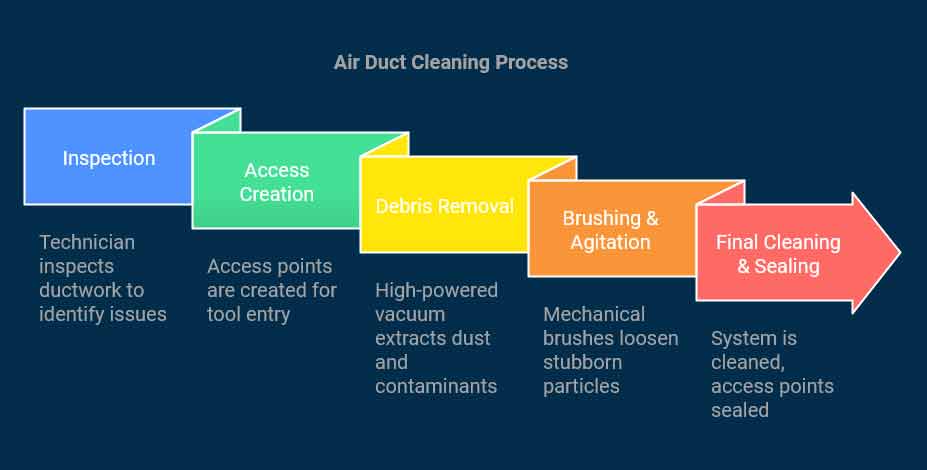
Today's equipment would astonish a 1970s operator. The centerpiece is negative pressure: a truck-mounted or portable HEPA-filtered vacuum connects to the main trunk line and puts the whole duct system under suction, so loosened debris travels one direction — out. Meanwhile, the agitation tools do the dislodging:
- Rotary brush systems sized to the duct, spinning on flexible cables through every run.
- Compressed-air whips and skipper balls that snake through branch lines, blasting debris toward the vacuum.
- Air washing for delicate or lined duct sections.
- Camera scopes — the game's biggest honesty upgrade — documenting conditions before and after, so the customer sees exactly what was found and what was removed. It is why a proper ductwork inspection now comes before any cleaning recommendation.
"The negative-pressure rig did for duct cleaning what the X-ray did for medicine — suddenly you could treat the whole system instead of the part you could reach." — the Elite Air Duct crew
A quick timeline of how the trade evolved:
| Era | Milestone |
|---|---|
| Pre-1900 | Hypocausts, smoke shafts, gravity ventilation systems |
| 1880s-1930s | Coal gravity furnaces; soot cleanup by hand |
| 1940s-1960s | Forced-air heating and central AC standardize ductwork |
| 1970s | Energy crisis seals buildings; indoor air quality emerges as a field |
| 1989 | NADCA founded; source-removal standards and certification |
| 1990s-2000s | Negative-pressure trucks, HEPA filtration, rotary tools mature |
| 2010s-today | Camera inspection, robotics, before-and-after documentation as standard practice |
Frequently Asked Questions
When did air duct cleaning become an industry?
It professionalized in 1989 with the founding of NADCA, which brought standards and certification to work that had existed informally since forced-air heating spread in the mid-twentieth century.
What did people use before modern duct cleaning equipment?
Brooms, rags, sweep brushes on rods, shop vacuums, and compressed air — tools that reached only the first few feet and often just relocated the dust.
What is negative-pressure duct cleaning?
It is the modern standard method: a high-powered HEPA vacuum puts the entire duct system under suction while brushes and air whips knock debris loose, so everything travels out of the house instead of into it.
Has the advice on how often to clean ducts changed?
It has gotten more conservative and more honest. Current NADCA guidance is inspection on a regular schedule and cleaning as conditions warrant — commonly every three to five years — rather than the annual cleanings some early operators pushed.
What changed the industry most?
Two things: negative-pressure equipment, which made whole-system source removal possible, and cheap cameras, which made honesty verifiable. Together they turned "trust me" into "see for yourself."
From Soot Buckets to Standards
The trade came a long way from coal-dust chores — and the through-line is proof over promises. That is the tradition we work in: Elite Air Duct has served the Denver metro since 2014 with NADCA-style source removal, camera documentation, and before-and-after photos on every job. Curious what a few decades of dust looks like in your own ducts? Browse more guides on our blog, or call (720) 551-5882 for a free estimate on a residential duct cleaning.